Directed by Jim Jarmusch, 1995, 115 minutes
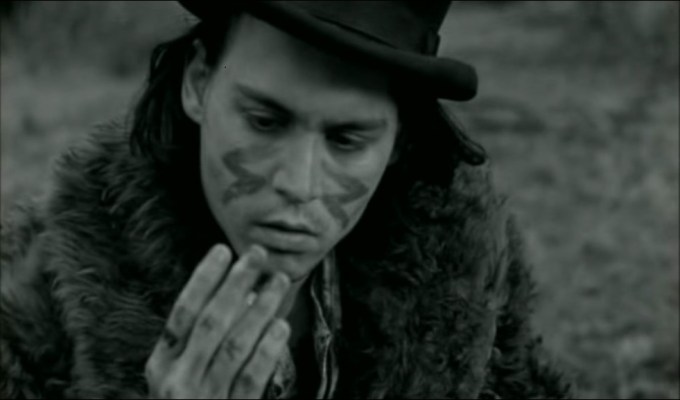
William Blake (Johnny Depp) spends the last of his money to travel to the town of Machine where he has been offered a job in the accounts department of the town’s iron works. On arrival, he learns that someone else has taken his post and is turned away. Later Blake is shot and flees, wounded into the night. Pursued by bounty hunters and marshals, Blake meets Nobody (Gary Farmer), an outcast native American who guides him on his journey.
Combining the screen western with the work of eighteenth-century poet William Blake may seem an eccentric notion. Blake is an oddity, in the awkward taxonomy of literary genre he’s labelled as a romantic poet but although like his contemporaries Byron, Shelley and Wordsworth he commented upon the social turmoil of the industrial revolution his work is very different in style and tone. His poetry is best read alongside his graphic work where his plain, declamatory language burns as bright as the vivid colours of his engravings. His style anticipates the dynamic interplay of text and image found in the graphic novel. Blake stood apart from the mainstream, his work appreciated more by other poets and artists than by the public at large. Jim Jarmusch is also an outsider whose distinctive work pursues his own interests rather than popular taste. Clearly a reader, Jarmusch’s films are suffused with literary references: Just as Blake’s poetry helps Nobody to understand the world around him, the vampires in ‘Only Lovers Left Alive’ (2013) are sustained by music and literature; in ‘Paterson’ (2016) poetry enriches a bus drivers humdrum daily routine. Blake’s verse has a timeless quality which transcends cultural boundaries; the language is direct even if the metaphysics are sometimes a little obscure. Blake yearned for a return to primal innocence and shared his own Eden with his wife Catherine at his cottage in Felpham (much to the distress of his neighbours). His work fits the frontier well, this new world a potential ‘Garden of Love’ corrupted by fallen men and ‘…filled with graves’. Jarmusch finds surprising and apposite assonance between Blake’s verse and the western myth. These references may be very subtle, easy to miss but ‘Dead Man’ rewards attentive repeat viewing: Blake meets a prostitute called Thel (Mili Avital) who sells paper roses in a sequence that satisfyingly connects Blake’s poems ‘Sick Rose’, ‘Book of Thel’ and ‘London’. Like Blake the poet, Blake the Accountant, and his spirit guide Nobody face a world convulsed by violent social change with a disconcerting mixture of childlike innocence, moralistic rage, and spiritual insight.
Long perceived as a profoundly conservative genre the cinematic Western has proved itself to be a flexible thematic and narrative form. Revisionist westerns like Kevin Costner’s ‘Dances with Wolves’ (1990) brought sensitive masculinity to the frontier seeking atonement for the social and ecological havoc wreaked by manifest destiny and in ‘Unforgiven’ (1992) Clint Eastwood mercilessly deconstructed the mythic persona of the gunslinger to uncover the flawed, damaged men beneath the surface. In ‘Dead Man’ Jim Jarmusch uses the nineteenth century American frontier as setting for a dreamlike progress from innocence, though experience to a kind of enlightenment. The portrayal of the West as an arena for self-discovery is nothing new: Alejandro Jodorowsky depicted the old West as a crucible for mystical rebirth in ‘El Topo’ (1970), but Blake’s quest feels rather less arcane, more haphazard.
Like Sergio Leone’s ‘Once Upon a Time in the West (1968) Jarmusch’s western has “…something to do with death” as we accompany William Blake on a picaresque pilgrimage into oblivion. Along the way fresh-faced Depp makes a convincing transition from innocence to experience, increasingly pale-faced and hollow-eyed as the film progresses. Blake is no Billy the Kid or Jesse James. His sensitivity and gentleness mark him as an alien figure in the harsh, masculine world of the nineteenth century west yet violent death haunts his journey. He becomes a frontier grim reaper despite himself. Unlike many western heroes or anti-heroes, he is driven by neither vengeance nor expiation. Blake’s progress is slow but relentless; his path defined from the start of the film, like a bullet fired at a target. As he approaches his own destiny, he seems fated to drag other souls along with him. Jarmusch sensibly avoids a moralistic approach and leaves the issue of whether Blake ultimately finds enlightenment or redemption up to the audience. Depp’s performance is matched by a wonderfully wry turn from Gary Farmer who constantly undermines genre stereotype with dry humour and profound, but understated wisdom. His observations on philosophy, clashing cultures and the realities of tribal life anchor the film, guiding Blake through the chaos of a dying world towards whatever may lie beyond.
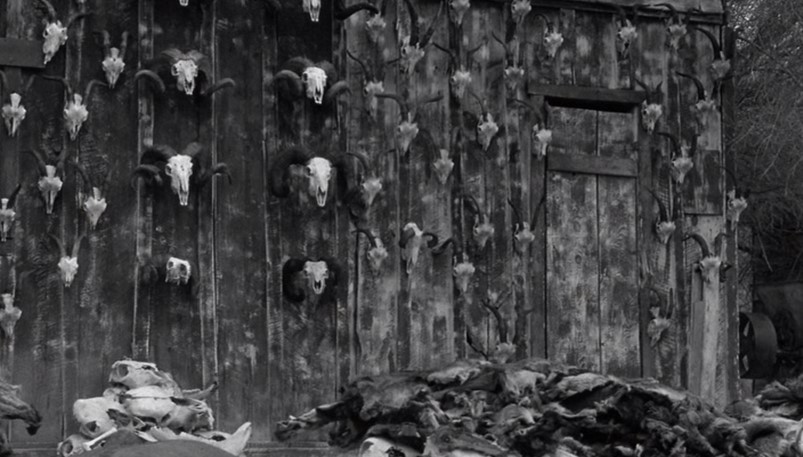
Robby Muller’s black and white photography is elegant and sharp. Inspired by Ansell Adams he conveys the cold beauty of the frontier’s wide-open spaces. These clean vistas are set against the wretched squalor of the iron town Machine, heaped with bones and waste. Blake’s walk down Machine’s main drag is one of the films high points: A sickly horse urinates copiously into the mud whilst a woman gives vigorous head at gunpoint in plain view of the impassive locals. In opposition to the driving spirit of many westerns, where man brings civilization to the wilderness; the film presents industrialisation and urbanisation as a blight, like the infected blankets sold to the natives by Alfred Molina’s bigoted missionary. Jarmusch doesn’t romanticise the indigenous people as noble savages; this is a nuanced portrayal of an ancient and besieged culture who look on in bemused horror at the ‘stupid white man’ whilst heading inexorably, like Blake through apocalypse towards extinction. Death comes to us all. The only choice left is how to face it.
Despite its elegiac tone ‘Dead Man’ is also very funny. Bounty hunter Cole Wilson (Lance Henrickson) hardly ever speaks. We are sombrely informed by his reluctant traveling companion Conway Twill (Michael Wincott) that Wilson copulated with and then ate both his parents. Twill, in contrast talks far too much, he spouts an incessant, bizarre monologue and sleeps with his teddy bear. Their fellow bounty hunter Johnny ‘The Kid’ Pickett (Eugene Byrd) is little more than a foppish teenager who has, apparently, killed 14 men. The bounty hunter is normally a solitary creature and, suffice to say there are some tensions within this group. Billy Bob Thornton, Iggy Pop, and Jared Harris play a bizarre trio of backwoodsmen. Iggy (in drag) regales his companions with a strange version of ‘Goldilocks’ and enthusiastically describes the martyrdom of early Christians. The conversation turns to personal grooming, knives, and beans as they paw the nervous Blake in a disquieting manner. The evening’s festivities end in one of the most surreal (and hilarious) gunfights ever committed to film.
A simple but resonant solo guitar soundtrack by Neil Young greatly enhances the films mood. This is smoker’s cinema par excellence (virtually every character in the film is seeking tobacco). The funereal pacing and sonorous soundtrack may induce a languid state but some intense, psychotropic imagery, a host of entertaining cameos (including Robert Mitchum and John Hurt) and sheer deadpan wit command the attention. Jarmusch’s reliance on synchronicity and coincidence as a plotting device may stretch the credulity of some viewers, but such minor details are soon forgotten in the face of ‘Dead Man’s good humour and solemn beauty. ‘Dead Man’s hallucinogenic journey through the frontier does for the American West what Coppola’s ‘Apocalypse Now’ (1979) did for the Vietnam War. Jarmusch has created a gritty but magical film which confounds expectations, offering a satisfying meditation on mortality and the promise of transcendence.
Quotes:
“And doesn’t this remind you of when you were in the boat? And then, later that night you were lying looking up at the ceiling and the water in your head was not dissimilar from the landscape, and you think to yourself, why is it that the landscape is moving but the boat is still?” Train Fireman (Crispin Glover)
“There’s possum in these beans, and spices too. I tried hard.” Salvatore ‘Sally’ Jenko (Iggy Pop)
“Are you William Blake?” US. Marshall (Jimmie Ray Weeks) “Yes, I am. Do you know my poetry?” William Blake (Johnny Depp)
Connections:
Films and Television
‘Once Upon a Time in The West’ directed by Sergio Leone (1968)
‘El Topo’ directed by Alejandro Jodorowsky (1970)
‘Apocalypse Now’ directed by Francis Ford Coppola (1979)
‘Dances with Wolves’ directed by Kevin Costner (1990)
‘The Unforgiven’ directed by Clint Eastwood (1992)
‘Ravenous’ directed by Antonia Bird (1999)
‘Wisconsin Death Trip’ directed by James Marsh (2000)
‘The Claim’ directed by Michael Winterbottom (2000)
‘Deadwood’ created by David Milch, HBO (2004-2006)
‘Slow West’ directed by John Maclean (2015)
Reading
William Blake, The Complete Poems, Penguin, 1977, ISBN 978-0140422153
If you can, seek out:
William Blake: The Complete Illustrated Books, Thames and Hudson, 2000, ISBN 978-0500282458
The poetry works best when read in tandem with Blake’s art and designs
Richard Thornley, Coyote, Jonathan Cape, 1994
Jonathan Rosenbaum, Dead Man (BFI Modern Classics), BFI Publishing, 2000, ISBN 978-0851708065
Music
Kristin Hersh, Strings (1994), Hips and Makers (1994), Murder, Misery and Then Goodnight (1998)
Neil Young, After The Gold Rush (1970), Dead Man Original Soundtrack (1995)
 simplysourdust
You must be logged in to post a comment.