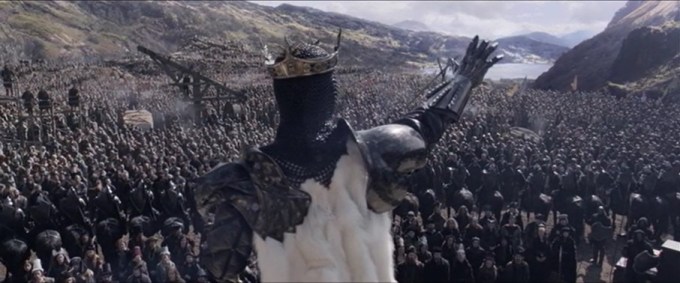
directed by Guy Ritchie, 2017, 126 minutes
Young prince Arthur (Charlie Hunnam) is orphaned when his uncle Vortigern (Jude Law) seizes the throne. Brought up on the streets of Londinium he must harness the power of a legendary sword to reclaim his kingdom.
Arthur and his knights Gawain, Perceval and Lancelot are amongst the first and most enduring fictional heroes. Their origin remains obscure and although Arthur is usually identified as English his stories have been told in many languages. In 13th century Europe troubadour tales of Lancelot and Guinevere encountered Chrétien De Trois’ mystical lore of the Grail. They travelled to England with the Normans where they collided with the Chronicles of Geoffrey of Monmouth, an imaginative hotchpotch of ‘factual’ history and folklore including Merlin, the sorcerer who lived his life backwards, hibernating kings, and magic swords. Legend and history coalesced into a convenient foundation myth for a ruling class eager to consolidate power. Although Arthurian legend has often served the interests of the elite, these stories found wider audiences through retelling and became part of popular culture. Long before they were fixed in print scribes changed and reinterpreted the works they copied, enlivening their work with contemporary references. Arthur rode in the vanguard of print culture and Thomas Malory’s ‘Morte d’Arthur’ was one of the first printed books. More recently Arthur has become convenient cinematic shorthand for all things mediaeval: Cineastes may extol Bresson’s ‘realist’ ‘Lancelot du Lac’ (1974) but the knights of the round table have taken many forms, including carny bikers (‘Knightriders’, George Romero, 1981), 21st century schoolchildren (‘The Kid Who Would Be King’, Joe Cornish, 2017) and, of course the coconut-clopping buffoons of ‘Monty Python and the Holy Grail’ (Terry Gilliam and Terry Jones, 1975).

Director Guy Ritchie seems an odd match for Arthur. His hits ‘Lock, Stock and two Smoking Barrels’ (1998) and ‘Snatch’ (2000) champion the little man, neighbourhood heroes who are legends in their own minds (or at least the local boozer). Following their lucrative Sherlock Holmes reboot Ritchie and screen writer Lionel Wigram applied a similar strategy to Arthur combining unconventional characterisation with a deft remix of familiar story elements. This time round their luck failed. Toxic criticism kept audiences away and stymied ambitious plans for a new Arthurian franchise. Although ‘Legend’ is no masterpiece, neither is much else in the Arthurian canon. Malory’s bloated opus, with its repetitive stock phrases and dour tone is an endurance test for twenty first century readers. Boorman’s epic ‘Excalibur’ (1981) comes closest to Malory, who seems equally uncomfortable with the more mystical elements of the grail legend. Ritchie chooses a less reverential approach which borrows visually from successful fantasy epics like Peter Jackson’s ‘Return of the King’ (2003) or HBO’s ‘Game of Thrones’ (David Benioff, D.B Weiss, 2011-2019). Production Designer Gemma Jackson makes no attempt to fix Arthur into the ‘real’ mediaeval period and instead the setting feels more akin to the high fantasy of George Martin or Robert Jordan. Londinium is clearly built in the ruins of the Roman Empire but unlike Antoine Fuqua’s ‘King Arthur’ (2004) there is no effort to recreate the post-Roman dark ages. Cinema and television often portray the mediaeval world as a dark and squalid place where the Arthurian court shines out as a beacon of civilization. Ritchie keeps Londinium at the centre of the action, a colourful and cosmopolitan city grittier than the fairy tale Camelot of films like Jerry Zucker’s insipid ‘First Knight’ (1995) with their deferential, well-scrubbed peasants. As in Ritchie’s portrayals of modern London, streetwise repartee struts and swaggers, everyone is on the make or looking for an angle.
Following Malory, young Arthur grows up in exile but in ‘Legend of the Sword’ Londinium provides the crucible where his character is forged, he receives his life-lessons on the streets rather than as a squire in a noble house. Arthur and his crew are self-made men; despite their boisterous behaviour they retain a rugged sense of social justice. Like so many operators in our own post-industrial society they must sometimes work outside the law to get by. In his short story ‘What Washington? What orders?’ (1973) author William Burroughs posited a reality show where the British royals must prove their social worth by operating an inner-city grocery store; here Arthur proves he’s a thoroughly good egg by running a brothel. It’s a shame that Ritchie can’t offer us a truly proletarian hero. Historically, monarchs have co-opted Arthurian myth to legitimise their rule and bolster national unity. Despite the moribund and anachronistic nature of the institution, British and American audiences retain their fascination with monarchy and eagerly consume royal spectacle. Additionally, Netflix allows us to replay the last fifty plus years of The House of Windsor as soap opera in ‘The Crown’ (Netflix, created by Peter Morgan, 2016-2023). Ritchie’s Arthur may be scathingly critical of the aristocracy and his knights may be chosen on merit, but only a born king can rule. Egalitarianism remains a step too far for Arthurian cinema. Antoine Fuqua’s ‘King Arthur’ (2014) depicts a Roman soldier who is elected king on the strength of his compassion and sense of justice, sadly this handsome, underrated film was derided for straying too far from traditional royalist and nationalistic tropes.
Fans of Ritchie’s previous work will feel at home: ‘Legend of the Sword’ is rather laddish. It lacks the rich comic banter of ‘Snatch’ or ‘Lock, Stock’ but still feels like a boy’s night in the pub with football on the telly, particularly when David Beckham turns up in cameo. Charlie Hunnam plays Arthur as the Grand Geezer of the Round Table, his knights are a fantasy football pipe dream, eyes on the ball, gently competitive but sportsmanlike in their dealings with the opposition. Women remain on the side-lines, supporters rather than players. In fairness, Ritchie intended his film to start a franchise and some characters, particularly the unnamed mage (Astrid Bergès Frisbey), who may be Morgana Le Fay, Guinevere (or even Merlin) could have become central players in later films. Ritchie’s hyperactive visuals are complemented by a stunning score by Daniel Pemberton. At times his music lifts the film to much greater heights than the visuals can achieve alone. Pemberton’s approach is inventive and eclectic, from the frantic breath music and percussion of the Londinium chase to the stirring pastiche folk which accompanies Arthur’s hallucinogenic ride into battle. This is remarkable work, even if you don’t fancy the film, seek out the soundtrack.

As a rousing origin story ‘Legend of the Sword’ feels fresh and optimistic but Arthurian myth is woven with a rich strand of melancholy. Malory’s Arthur fails as both husband and king, rejected by his subjects, undone by own frailty, his ambition to create a just kingdom thwarted by internecine strife. It is no coincidence that Camelot has been identified with the Kennedy presidency, with its shattered idealism and fallen king. Accordingly, ‘Legend’ has some darker elements: Jude Law’s Vortigern discovers that magic demands appalling personal sacrifice and there are suggestions that Excalibur itself may be a double-edged sword. We can only speculate how Ritchie’s alternative Arthur would have developed in later films. Meanwhile, in Charlie’s Kingdom we are ruled from the high, rather than the round table, waiting like awestruck toddlers to collect any morsels that fall into our coronation cereal bowls. We congratulate ourselves at how well royal spectacles are policed and applaud as republican protestors are hustled away by enforcers in black. Mythical Arthur endures because he represents a comforting fantasy of equality and service, an unbroken social contract. Malory, who may have written his tales of chivalry in prison whilst awaiting trial for pillage and murder would probably feel more at home in our little fiefdom. If Arthur sleeps on, ready to ride forth and save his countrymen, he’d best do it soon.
‘Legend of the Sword’ lacks the self-confidence of Ritchie’s Holmes reboot, but it doesn’t deserve the opprobrium that buried it at the box-office. Some Brits retain a strong, proprietary affection for Arthur, and this colours their response to those who take their “Once and Future King” in vain or ‘misuse’ beloved characters but criticising Ritchie because he reconfigures traditional Arthurian myth is unfair; legends survive through retelling and embellishment. The very notion of Arthur as national myth is nonsensical, these tales demonstrate the insoluble cultural links between the British Isles and continental Europe. Part of the pleasure of Ritchie’s film lies in its iconoclastic tone but he falters when he chooses to play safe rather than embrace risk. Ritchie’s cheeky attempt to kick Camelot up the backside is both fascinating and infuriating but disregard the bad press and decide for yourself.
Quotes:
“I’ve never had any power, or any desire to achieve it.”
Arthur (Charlie Hunnam)
“Put your ring back on honey-tits, you haven’t had enough porridge this morning to talk like that. And if you want that sword so much, your lordship, you can keep it… to peel your grapes.”
Arthur (Charlie Hunnam)
Connections:
Film
‘Excalibur’ directed by John Boorman, 1981
‘Sherlock Holmes’ directed by Guy Ritchie, 2009
‘The Green Knight’ directed by David Lowery, 2021
Reading
T H White, The Sword in the Stone, 1938
W S Burroughs, Exterminator!, 1973
Radio
 simplysourdust
You must be logged in to post a comment.