
directed by Francis Ford Coppola, 2024, 139 minutes
As New Rome faces bankruptcy, Nobel Prize-winner Cesar Catilina (Adam Driver) promises a city rebuilt using his organic technology, the Megalon. City Mayor Cicero (Giancarlo Esposito) and Clodio Pulcher (Shia LaBeouf), heir to banking magnate Hamilton Crassus III (John Voight) oppose him but Julia Cicero (Nathalie Emmanuel) is drawn to Catilina’s visionary idealism.
It may not have been the ides of March, but something terrible happened on the way to the forum. Knives were sharpened, drawn, and in a sudden flurry of flapping togas Francis Ford Coppola, elder statesman of American cinema lay bleeding on the cold marble. Critics lay in wait to eviscerate Coppola’s sprawling, self-funded passion project ‘Megalopolis’ but unlike those that queued to hurl rotten eggs at the grand old man I come not to bury Coppola, but to praise him. His infuriating, bizarre lovechild merits closer inspection even if it has a face that only a parent could love. It’s partly a problem of definition. Canny consumers like to know exactly what they are buying but Coppola’s film is a misshapen hybrid, part sword and sandals epic, part science fiction and part scabrous political satire. As shadows lengthen in a darkening world Francis Ford throws a lavish farewell bacchanal in the grand Roman style. We’ve been invited to a toga party but everyone else shows up overdressed in cast off Lagerfeld; the exotic fare looks appetising, but some of the food has spoiled and our mischievous host has spiked the wine with some LSD left over from the shoot of ‘Apocalypse Now’. As any political and philosophical chatter is drowned out by a cacophony of boisterous sex and excessive flatulence traumatized guests scramble for the vomitorium.
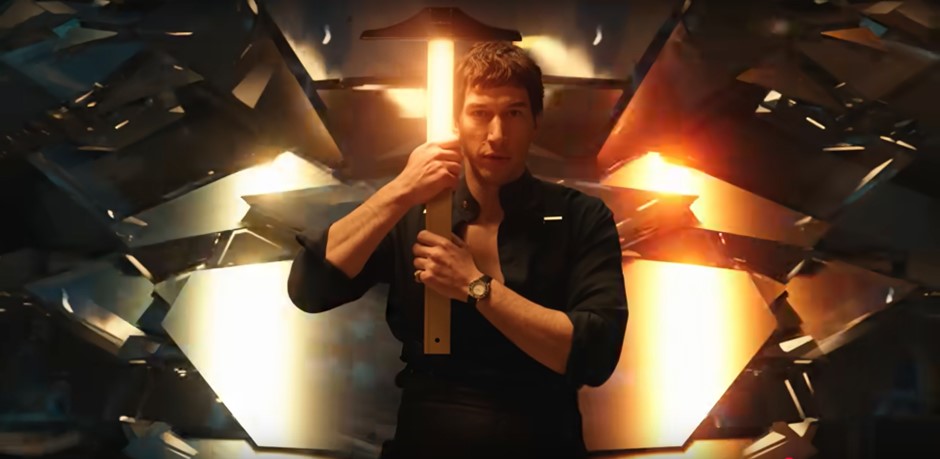
This is certainly a wild party and Coppola has his fun. When oddball protagonist Cesar Catilina is introduced, he spouts clichés from ‘Hamlet’, mocking the stately blank verse of highbrow costume drama. At first sight ‘Megalopolis’ resembles anachronistic Shakespearean adaptations like Ralph Fiennes ‘Coriolanus’ (2011) or Julie Taymor’s ‘Titus’ (1999); costume designer Milena Canonero also worked on Taymor’s film and seems to have recycled some of her wardrobe here. ‘Megalopolis’ abounds with pointed classical references. Character names roughly correspond with players in the Catiline conspiracy which preceded the rise of Julius Caesar and Coppola’s Cesar remains a deeply ambivalent figure. Aspiring demagogues have long admired the great god emperor but even humble republican idealists like Cromwell and Napoleon eventually succumbed to imperial despotism. As Mayor Cicero points out, utopias usually mutate into dystopias, but New Rome’s bankrupt democracy is tottering because its leaders lack vision; Cesar derides Cicero’s plan to revitalise the city by constructing a super casino. Alas, Coppola may aspire to the biting wit of Juvenal or Petronius, but the dialogue is closer to ‘Carry on Cleo’ (Gerald Thomas, 1964) and the satire quickly descends into broad farce. He may be trying to recall the bawdy late-sixties irreverence of ‘Catch 22’ (Mike Nichols, 1970) or Robert Altman’s ‘MASH’ (1970), but ‘Megalopolis’ turns out more like ‘Something Funny Happened on the Way to the Forum’ (Richard Lester, 1966) or ‘Up Pompei’ (Bob Kellett, 1971). Cinematic Ancient Rome is, at best, a confection offering a tasty mix of titillation with a few comforting homilies along the way. Like most historical cinema, it wants to feel content that things are so much better now. Viewers with stronger constitutions should seek out ‘Fellini Satyricon’ (1969) which takes us to a hostile, incomprehensible world that leaves us reeling, an alien landscape paradoxically very much like our own. Hollywood has always admired imperial excess and it’s all too easy to draw parallels between ancient Rome and the United States of the twenty-first century, another proud republic heading for a fall. Here the imperial metaphor feels stale, there is too much passion and not enough precision. Ten years before most of us had heard the name Elon Musk, David Cronenberg brought Don DeLillo’s novel ‘Cosmopolis’ to the screen. The screenplay, co-written with DeLillo, delivers a masterclass in focus and clarity. ‘Cosmopolis’ dissects the dangerous psychopathology of the billionaire technocrat whilst documenting how technology subverts and corrodes democratic systems. Perhaps Cronenberg’s cool prescience was easier ten years ago. Now, as madmen howl at the moon Coppola bays along with them. Yeats may have had a point when he asked, “Why should not old men be mad?” but Coppola’s bewildered indignance is too blunt for incisive socio-political critique.
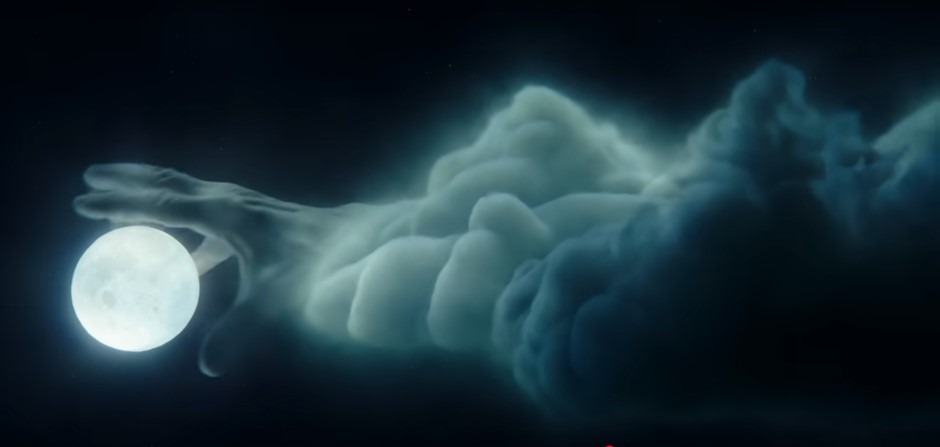
Prospective visitors to ‘Megalopolis’ are advised to travel via Fritz Lang’s ‘Metropolis’ (1927). Say the titles aloud: ‘Metropolis’ trips from the tongue, sleek and elegant as the art-deco stylings of Lang’s film. ‘Megalopolis’ twists the tongue with one syllable too many, an ugly word for an ugly concept. ‘Metropolis’ denotes ordered civic space, a culture of control; ‘Megalopolis’, derived from Catilina’s architectural MacGuffin also suggests too many people crammed into insufficient space, bloated and dyspeptic. These films, released almost a hundred years apart, whisper anxiously across the sickbed of the twenty-first century. Both are box-office failures that favour visionary flair over incisive debate. Lang’s futuristic cityscape still stuns viewers and inspires imitation but Coppola’s glowing walkways and gyrocars never quite capture the magic conjured in the architect’s head. Sequences showing Catilina at work are thrillingly lyrical, when we see the world through his dreamy idealism, we are almost convinced. Coppola recalls his psychedelic phase and bombards us with a dizzying salvo of dream imagery and artistic reference. Cesar stops time, literally reaching for the moon; he addresses the masses from atop Max Ernst’s ‘The Entire City’ (1934) and envisions the fall of western civilization during a rainy odyssey through a wilderness of broken gods. Both Coppola and Lang present their fictional cities as metonyms to explore urgent contemporary issues, and both were released the on very brink of violent political crisis. Although now considered a prophetic masterpiece, ‘Metropolis’ was also savaged by critics on release, left cut and defaced, incomplete to this day. In a 1971 interview Lang recalled feeling that screenwriter Thea Von Harbou’s platitudinous resolution was too glib. The ending of Coppola’s ‘Megalopolis’ film feels very similar. New Rome may be crying out for change, but we are left feeling that we have been fleeced by Cesar’s Shakespearean rhetoric and blind faith in technology.
First night reviewers have often recoiled in horror at Coppola’s visionary excess but in hindsight opinion has mellowed. Even his harshest detractors grudgingly commend the exhilarating stage magic of ‘Dracula’ (1992) and intricate, studio-bound dreamscapes of ‘One From the Heart’ (1981). Like his friend George Lucas, this inveterate tinkerer has reworked some of his most notable flops, but he is going to have to get his skates on if he wants to revisit ‘Megalopolis’. Like Charles Foster Kane’s Xanadu, most regard Coppola’s folly as a pathetic monument to overreaching ambition and self-delusion. If anyone is still writing, or still cares, fifty years hence, ‘Megalopolis’ may be remembered as an embarrassing footnote to a great career or a raucous commentary on the collapse of democracy in the United States. For now, it is worth crashing Coppola’s wild party even if only to bid farewell and share a dirty joke with this erratic, eccentric genius. The old reprobate laughs heartily as he gives the finger to cinematic history, reputation and the grim reaper himself, who waits by the glowing exit sign as the lights come up and the exhausted guests shuffle out. As he approaches his ninetieth year, the prodigious talent that gave us Brando as Colonel Kurtz shrugs off critical assault, lies back on his laurels and blows a raspberry at the Academy. Coppola, a magnanimous host, is determined to have his fun, and we should too. If you have a strong stomach and a robust sense of the absurd, bring a couple of bottles (or something stronger), and party like its 1999.
Quotes
“And you think one year of… medical school entitles you to plough through the riches of my Emersonian mind?” Cesar Catilina (Adam Driver)
“Revenge is best in a dress!” Clodio Pulcher (Shia LaBeouf)
Connections
‘Metropolis’ directed by Fritz Lang (1927)
‘Sign of the Cross’ directed by Cecil B DeMille (1932)
‘Fellini Satyricon’ directed by Federico Fellini (1969)
‘The Wild Party’ directed by James Ivory (1975)
‘Caligula’ directed by Tinto Brass (1979)
‘Cosmopolis’ directed by David Cronenberg (2012)
‘High Rise’ directed by Ben Wheatley (2015)
‘The Brutalist’ directed by Brady Corbet (2025)
Radio
 simplysourdust
You must be logged in to post a comment.