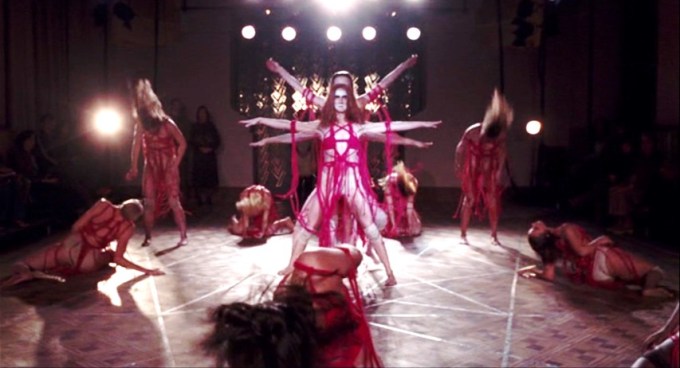
Directed by Luca Guadagnino, 2018, 152 minutes.
Autumn 1977, Susie Bannion (Dakota Johnson) leaves behind her Mennonite community and travels to West Berlin to study at the Markos Dance Academy under tutor Madame Veva Blanc (Tilda Swinton). Psychiatrist Josef Klemperer (Lutz Ebersdorf) investigates the disappearance of one his patients and becomes increasingly concerned about the Academy’s occult activities.
Luca Guadagnino’s ambitious remake of ‘Suspiria’ echoes and sometimes surpasses Dario Argento’s 1977 cult hit. So much has been written about Argento’s film that it’s difficult to discuss Guadagnino’s ‘Suspiria’ in isolation but in doing so we render him a disservice. Instead of Argento’s gaudy, dreamlike phantasmagoria we have an austere and realistic film, which engages the mind as much as the senses. Its cerebral approach alienated fans of the original film and deterred the casual viewer. Like the Markos Academy, Guadagnino’s film is full of secrets. Patient, attentive viewers who penetrate its uncompromising exterior, will discover that this ‘Suspiria’ has a compelling personality and wisdom of its own to impart.
Curious viewers seeking an entry point to Guadagnino’s film should begin with Thomas De Quincey’s hallucinogenic essay ‘Levana and our Ladies of Sorrow’ (1845). De Quincey was a sickly, anxious child with a cold and remote mother, instead, he sought affection from his sisters and obliging domestic staff. His melancholic disposition, exacerbated by a life marked by frequent bereavement and a profound need for nurture, found expression in his opium-fuelled vision of the Ladies of Sorrow. Dario Argento and Daria Nicolodi were clearly aware of De Quincey’s work but their engagement with its themes is more superficial. The malevolent Three Mothers that recur in Argento’s films bear little resemblance to the extraordinary figures described by De Quincey of which only Tenebrarum, (Darkness), approaches the demonic. Levana protects the newborn, Lachrymarum, (Tears), mourns the dead and Suspiria, (Sighs), ministers to outcasts and victims. Guadagnino uses De Quincey’s exquisite prose poem to challenge conventional representations of motherhood and femininity. Rejected by her own abusive mother, Susie must also transcend her idol and creative mentor Madame Blanc to discover her own destiny. Sarah (Mia Goth) describes ‘The Academy as a family, but Coven members (ironically designated as ‘Matrons’) groom students as surrogate bodies for ‘Mother’ Markos. The witches’ obsessional pursuit of immortality is a corruption of natural maternity; the hooks that they use to manipulate their victims resemble obstetric instruments, a travesty of midwifery. Susie may have escaped the strictures of her orthodox upbringing, but the Coven has its own plans for her. She must choose for herself what kind of woman she wants to be.
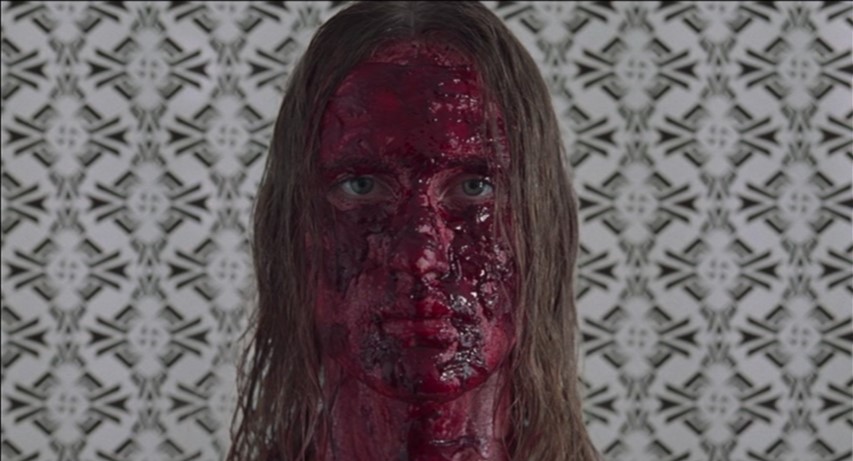
Of all the staples of horror cinema the witch remains the most divisive. A justifiable sense of guilt colours witchcraft cinema from ‘Häxan’ (Benjamin Christensen, 1922) to ‘Hagazussa’ (Lucas Feigelfeld, 2018) presenting the witch as victim of male oppression. Conversely, fairytale villainesses from ‘Snow White’ and ‘Sleeping Beauty’ have been re-interpreted as heroic, wronged women. Portrayals of unrepentant, violent witchcraft carry a more transgressive charge; in Robert Egger’s ‘Witch’ (2015) Anya Taylor Joy’s Thomasin rationally concludes that the witches that assail her family can also offer liberation from domestic and religious servitude. In ‘Suspiria’ coven members humiliate male authority figures with a bawdy gusto that recalls the scurrilous dissent of far-left feminism. In 1968, Hamburg feminists circulated a flyer protesting the patronising sexism of some of their male fellow travellers, it shows a grinning, hag-like figure reclining naked and brandishing an axe beneath a display of severed male members mounted as trophies. During the German Autumn of 1977 left-wing revolutionary women rejected motherhood to perpetrate and lead violent political action. Patricia Melzer has described how prurient media coverage of ‘terrorist girls’ (note the patronising diminutive) refused to accept their political agency and belittled their actions as the results of ‘excessive emancipation’, ‘sexual deviance’ or insanity. Like witches, these women were demonised because they disrupted deeply entrenched norms that conflate feminism, maternity, social passivity and pacifism. Guadagnino’s frank portrayal of female violence dismayed some feminist critics, but the most stringent test of equality is representation that runs counter to positive as well as negative stereotype. Critics like Anna Bogutskaya and Sally Christie have championed film characterisation that subverts prevalent tropes like chaste glamour or wholesome motherliness. Gender discourse in ‘Suspiria’ is nuanced, rather than misogynistic. The Marcos Academy is split, like any other community, between moderates and zealots. The witches of ‘Suspiria’ are intricately drawn characters rather than pantomime villains. The cast is a Who’s Who of remarkable actresses, luminaries like Reneé Soutendijk and Angela Winkler must have relished the chance to play something more interesting than granny or mother-in-law. Patricia (Chloë Grace Moretz) describes the Three Mothers as “Pre-God, pre-devil”; inscrutable and amoral they may be, but Guadagnino sets his incarnation of Suspiria in direct opposition to the violence and corruption of the Markos Coven.
The new ‘Suspiria’ reverses the visual extravagance of the first film. Colour is dialled back, almost monochrome, aside from eye-catching bursts of bloody red, like Madame Blanc’s gown or Susie’s hair. Some shots, like Susie’s initial approach to the Markos Academy are distorted mirror images of the original, as if Argento’s film has been reshot in an alternative reality. Despite the muted palette divided Berlin sometimes has a sombre, wintry beauty. Art Directors (Merlin Ortner and Monica Sallustio) and Production Designer (Inbal Weinberg) have recreated the city with meticulous attention to detail. Both Germany and Italy were riven by political strife in the late seventies but aside from its splashes of ostentatious violence little of the outside world penetrates the hermetically sealed Academy in Argento’s film. In contrast the outside world constantly seeps into the new ‘Suspiria’. Rioting demonstrators demand the release of Red Army Faction terrorists, Berlin is a melting pot of radical political theory but also a focus for artistic creativity. The avant-garde Markos Academy feels at home alongside the Berlin Wall close to Hansa Studios where Bowie is recording ‘Heroes’ whilst flirting uneasily with fascist imagery. Berlin is haunted by bad memories: Third Reich race laws and eugenics, Klemperer’s missing wife. Even the title of dance piece ‘Volk’ with its Nazi connotations testifies to how easily prejudice slides into fascism and the deadly consequences that ensue.

Thom Yorke’s deceptively simple score employs repetitive phrases but weaves them into structures of incredible intricacy. His meditative opener ‘Suspirium’ sums up the film’s themes lyrically in 15 succinct lines. Other highlights include the queasy, unsettling ‘Has Ended’ and the rapturous, apposite ‘Unmade’ which accompanies the film’s denouement. His greatest achievement is ‘Volk’, which recalls Bowie’s Berlin period, a musical essay in dynamic tension. Yorke’s music isn’t merely decorative, his first cinematic score demonstrates an intimate identification with action and theme. Dance is more than an incidental motif in the new ‘Suspiria’; like ‘Black Swan’ (Darren Aronofsky, 2010) it focusses on the gruelling physicality of performance. Choreographer Damien Jalet creates ritualistic shapes and movement that suggest a complex magical system. The members of the Marcos coven use dance to channel magical energy that unknits muscle and bone, reconfiguring the flesh. If the vivid, surreal violence of Argento’s film evokes the gaudy abstraction of Miró, Gaudagnino’s brutal somatic imagery is closer to the sculpture of Alina Szapocznikow or the photography of Francesca Woodman that remould the body into abstract organic forms.
Critical and audience disdain greeted the release of ‘Suspiria’, but time will be kinder to this intelligent, intense film. Despite startling disparities in visual style, the two versions of ‘Suspiria’ are revolutionary sisters under the skin, one a wild-eyed disco diva with sharp teeth, the other, wise with experience, sober and stately as a cenotaph. Together they share an intimate lover’s conversation, an elaborate, hypnotic dance into the dark. Guadagnino and writer David Kajganich imply that, despite their funereal demeanour, De Quincey’s ‘Ladies of Sorrow’ are hopeful figures. Suspiria and her sisters attest that nurture can transcend nature, that goodness (or wickedness) is learned rather than inborn; that a caring parent (regardless of gender or genetics) can repair the damage caused by ignorance and neglect. Despite the horrors that we have witnessed we leave ‘Suspiria’ stirred by a poignant act of merciful release which honours De Quincey’s vision of redemptive compassion.
Quotes
“My daughter, my last one. She’s my sin. She’s what I smeared on the world.”
Susie’s mother (Malgorzata Bela)
” We need guilt, Doctor. And shame. But not yours.”
Susie Bannion (Dakota Johnson)
Connections
Films
‘Suspiria’ directed by Dario Argento (1977)
‘Possession’ directed by Andrzej Żuławski (1981)
‘The Baader Meinhof Complex’ directed by Uli Edel (2008)
‘Black Swan’ directed by Darren Aronofsky (2010)
‘Berberian Sound Studio’ directed by Peter Strickland (2012)
‘Witch’ directed by Robert Eggers (2015)
Reading
Thomas De Quincey, Confessions of an English Opium Eater and Other Writings, Penguin, 978-0140439014, 2003 (pieces originally published 1821-1849)
Fritz Lieber, Our Lady of Darkness, HarperCollins, ISBN 978-0006148616, 1978
Patricia Melzer, Death in the Shape of a Young Girl, New York University Press, ISBN 978-1479864072, 2015
Philipp Felsch, Summer of Theory: History of a Rebellion 1960-1990, Polity, ISBN 978-1509539857, 2021
Patricia Allmer, The Traumatic Surreal: Germanophone Women Artists and Surrealism After the Second World War, Manchester University Press, ISBN 978-1526178831
Music
David Bowie, ‘Heroes’, RCA, 1977
Thom Yorke, ‘Suspiria’, XL Recordings, 2018
 simplysourdust
You must be logged in to post a comment.