(aka. The Devil’s Widow), Directed by Roddy McDowall, 1970, 106 minutes
Tom Lyn (Ian McShane) enjoys a leisurely life in the glamorous coterie of Michaela Cazaret (Ava Gardner). When he meets and falls in love with vicar’s daughter Janet Ainsley (Stephanie Beacham) he realises that he must escape from Cazaret’s influence.
The story of Tam Lin formed part of the Child Ballads collection first published late in the nineteenth century (see the various Tam Lin Versions here) but is much older. It tells of a young heroine (Janet or Margaret in some versions) who is seduced by the mysterious Tam Lin, a handsome but enigmatic Knight who lives under the thrall of a faery queen. To win back her lover the heroine must break the enchantment. Former child star Roddy McDowall passed on the opportunity to reprise his role as Cornelius in the commercially successful Planet of the Apes franchise to direct this personal project. Re-titled as ‘The Devil’s Widow’ by dumbstruck studio executives the film disappeared into obscurity upon release and has subsequently become almost a legend itself.
The story of Tam Lin has inspired constant re-interpretation and analysis since it was first recorded. Like many ancient tales this ballad warns listeners against the dangers of crossing borders: The heroine believes Carterhaugh to be her father’s property but when she enters this disputed territory, she must suffer the consequences of her trespass. McDowall’s film is set, like the original ballad, on the Scottish borders. He emphasises the remoteness of Carterhaugh from the modern world in a protracted opening sequence where Cazaret and her faery court ride north in a glamorous motorcade. Carterhaugh is liminal space where the supernatural world intersects mundane reality; the simple life of the neighbouring rural community is anathema to the sophisticated and alien ‘children’ of Cazaret’s court who live in a world of endless but shallow amusements and casual emotional cruelty.
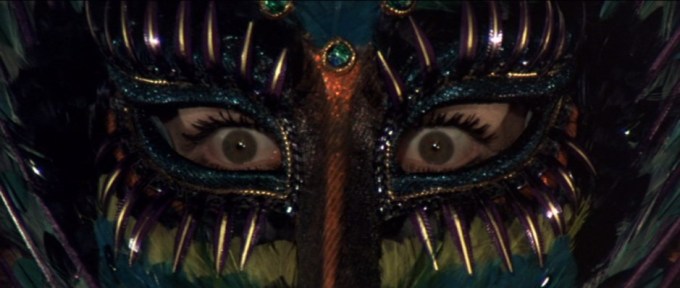
The film remains tastefully coy about the exact nature of life at Carterhaugh but suggests a narcotic and erotic fugue-state where favour is difficult to win and harder to keep. Ava Gardner is an imposing presence in her Balmain gowns: imperious, unpredictable and tyrannical. Her elegant ‘confidential private secretary’ Elroy (James Wattis) acts as the faery queen’s procurer and the suave, menacing Oliver (David Whitman) is master of ceremonies. Cazaret’s court features some well-known faces from British film and television including Joanna Lumley, Madeleine Smith and Sinéad Cusack. A former favourite now exiled from her presence is played by Bruce Robinson who went on to direct ‘Withnail and I’ (1986) which takes a similarly ambivalent but more affectionate view of sixties hedonism.
The ballad of Tam Lin offers a pragmatic study of sexual politics. The heroine pays for her trespass when Tam Lin rapes her and she becomes pregnant; this assault and its consequences drive the narrative forward. McDowall’s film is more ambivalent about the exact nature of Tom and Janet’s courtship and uses an odd mixture of freeze frame and still photography to portray this moment. Although it seems to begin as a drunken assault the disarming innocence of Stephanie Beacham and Ian McShane turns the film into story about the strength of true love. Like other modern interpretations, the film casts Janet as a strong, sympathetic heroine who must redeem her lover; she must decide whether to abort her child or reclaim the father and create a family.
In the original ballad Janet must break the faery queen’s enchantment by holding onto Tam Lin as he transforms into a succession of monstrous and dangerous forms. McDowall cleverly depicts this ordeal as a drugged nightmare in which Tom struggles to break free of Cazaret’s hold. As in other stories about the world of faery mortals are enticed by bargains or contracts designed to ensnare and imprison the unwary. Cazaret’ s money offers an idyllic existence for her ‘children’ but they must accept a life of emotional dependence, playthings subject to her unpredictable whims that can see them banished at any moment. Janet and Cazaret must ultimately bargain for Tom in a power struggle that may end in his death.
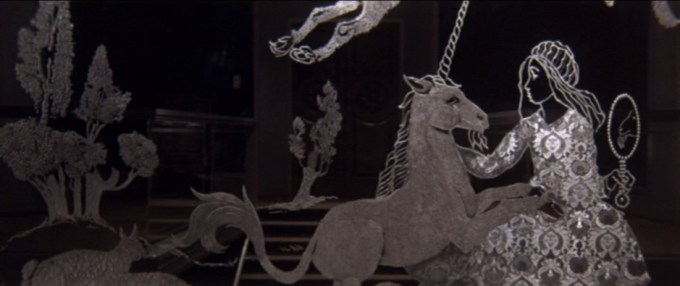
McDowall’s film of a screenplay by William Spier keeps most of the original ballad’s themes intact. Small details are deftly translated into modern imagery, like the white sports-car driven by McShane (instead of a white horse) or Cazaret’s bizarre sunglasses which may represent the eyes of wood or stone mentioned in the ballad. Period detail like the Space-Hoppers and Frisbees that are playthings for Cazaret’s ‘children’ now seem a witty touch. The film’s settings are full of artistic motifs from the ballad in painting, tapestry and sculpture. Stanley Myer’s score uses its own slightly updated version of the Tam Lin ballad performed by Pentangle, darlings of the English folk revival. ‘The Ballad of Tam Lin’ is a fascinating fusion of folk myth and dated modernity: Set now in our own past, the world of the late sixties and early seventies that it portrays is as distant to us as the faery landscapes of the ballads. This helps to counteract the film’s quaint visuals and gives it an appropriately alien, otherworldly feel in keeping with its subject. The film is shot by Billy Williams in the glowing light of a past summer, a pastoral idyll of the swinging sixties.
As a study of fairy tale ‘The Ballad of Tam Lin’ lacks the thematic and psychological complexity of Neil Jordan’s ‘Company of Wolves’ (1984). Its simplicity and conservatism are more in keeping with the tone of the original ballad. The ‘tithe to hell’ that Tom Lyn must pay is portrayed as a nightmare of bad hallucinogens and psychological collapse. Made at the end of the sixties the film forms part of a reaction to the emotional shallowness of the drugs, sex and glamour lifestyle decried by conservative social commentators. The rural world that the film depicts avoids the more nuanced portrayal found, for example in David Gladwell’s ‘Requiem for a Village’ (1975). This morally unambiguous world of love and family represented by the non-judgemental local ‘wise woman’ who advises Janet about her pregnancy and the gentle paternalism of her father the vicar (Cyril Cusack) is also a fantasy.

‘The Ballad of Tam Lin’ is an elegant but dated curio that sits comfortably within the folk revival of the early seventies and seeks refuge from the turbulence of social upheaval in illusions of a simpler life. This retreat to the green fields of the past encompassed the crossover of folk themes into pop culture and the burgeoning popularity of fantastic literature, particularly Tolkien’s ‘Lord of the Rings’ with its trenchant critique of industrialisation. McDowall’s lyrical evocation of a far-distant summer is a pretty and witty dream which eloquently illustrates the enduring capacity of folk ballad for adaptation and re-interpretation.
Quotes
“Hold on to me” Tom Lyn (Ian McShane)
“I’ll swallow anything as long as it’s illegal” Sue (Madeleine Smith)
Connections
Film and Television
‘Peau d’Âne’ (English title ‘Donkey Skin’) directed by Jacques Demy (1970)
‘The Wicker Man’ directed by Robin Hardy (1973)
‘Requiem for a Village’ directed by David Gladwell (1975)
‘The Company of Wolves’ directed by Neil Jordan (1984)
‘Arcadia’ directed by Paul Wright (2017)
Reading
Susan Cooper and Warwick Hutton, Tam Lin, Atheneum, 1991
Pamela Dean, Tam Lin, Saint Martin’s Press, 1992
Robert Irwin, Satan Wants Me, Dedalus, 1999
Alan Garner, Red Shift, Collins, 2002
Suzanne Clarke, Jonathan Strange and Mr Norrell, Bloomsbury, 2004
Charles Vess, The Book of Ballads, Tor, 2004
Suzanne Clarke, The Ladies of Grace Adieu, Bloomsbury, 2006
Elizabeth Bear, Blood and Iron, Roc, 2006
Dianne Purkiss, Fairies and Fairy Stories: A History (originally published as ‘Troublesome Things’), Tempus, 2007
Rob Young, Electric Eden: Unearthing Britain’s Visionary Music, Faber, 2010
Diane Wynne-Jones, Fire and Hemlock, HarperCollins, 2011
Music
Anne Briggs ‘Young Tambling’ from ‘Anne Briggs: A Collection’, Topic, 1999 – this is the most comprehensive version listed here.
Sandy Denny ‘Tam Lin’ from ‘The Best of Sandy Denny’,Universal, 2007
Steeleye Span ‘Tam Lin’ from ‘Tonight’s the Night Live’, Shanachie Entertainment, 2005
Mediaeval Baebes, ‘Tam Lin’ from ‘Mirabilis’, EMI, 2005
Benjamin Zephaniah, ‘Tam Lyn Retold’ from ‘The Imagined Village’, Real World Records, 2007
Anaïs Mitchell and Jefferson Hamer, ‘Tam Lin’ from ‘Child Ballads’, Wilderland Records, 2013
NB There are many musical and literary re-workings of the Tam Lin story, and this is not a comprehensive list.
Radio
 simplysourdust
You must be logged in to post a comment.