Directed by Brady Corbet, 2015, 116 minutes
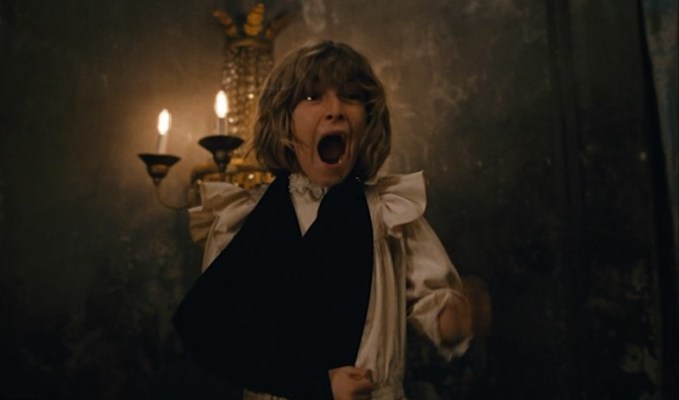
In autumn 1919 delegates gather in Paris to broker peace in the wake of the Great War. Prescott (Tom Sweet), a young boy whose father (Liam Cunningham) is part of the US delegation, and his mother (Bérénice Bejo) adapt to life in a small French village. As the byzantine political debate plays out Prescott’s behaviour becomes increasingly erratic.
Many who watched ‘The Childhood of a Leader’ back in the days of the Obama presidency must have found it a rather alienating experience. Although it garnered a measure of critical acclaim it was met with bemused indifference by most viewers. Corbet and co-writer Mona Fastvold based their screenplay on a short story by Jean-Paul Sartre, and the film was shot in Hungary, with European funding. It is set in the immediate aftermath of the “war to end war” as victors and vanquished gather in Paris to divide the spoils and rebuild the world. These negotiations, hamstrung by irreconcilable clashes of self-interest tilled the ground for a second global holocaust and seeded many of the conflicts that continue to shape our lives today. US President Woodrow Wilson’s delegation to the Paris negotiations plays a central role here, but this unashamedly cerebral and outspoken film feels distinctly European in outlook and style. Like Pasolini’s ‘Salò or the 120 Days of Sodom’ (1975), another uncomfortable, forensic examination of fascist mentalities, ‘Childhood’ is divided into a series of titled, theatrical acts. It begins with an orchestra tuning up before launching into sixties pop legend Scott Walker’s pugilistic score. His punishing, rhythmic overture squares up to the audience like a boxer sparring before a prize-fight. Newsreel footage drags the viewer back in time to witness the end of one war and beginning of a fractious, troubled peace. France has borne the brunt of war, the landscape littered with battlefields and mass graves, many of the dead remain uncounted, many are still missing. We find ourselves on a train crossing this wasted landscape at night. Alongside the tracks, shadowy figures display messages of welcome for the US delegates, their words, scrawled on bedsheets, reflect the desperate hopes of a demoralised population. The camera arrives at a candlelit window to reveal the profile of our protagonist Prescott, an angelic golden-haired child. As he haltingly announces the birth of a messiah in a village nativity play, William Butler Yeats’ ‘Second Coming’ (written in 1919) echoes unspoken in the murky winter darkness.

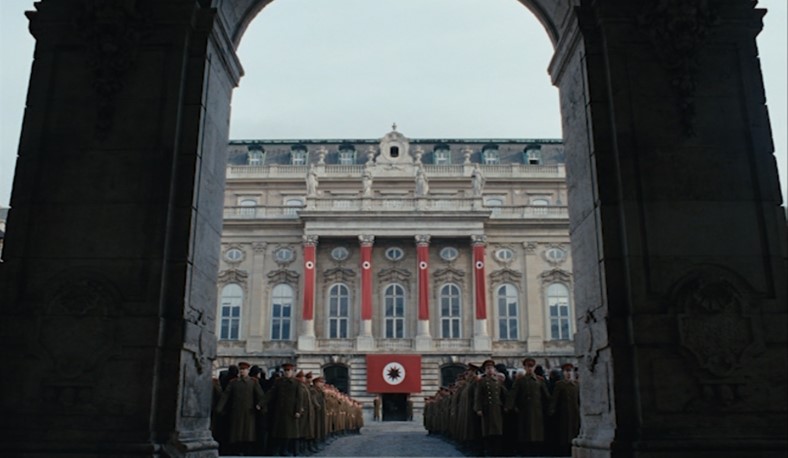
Fascinated by the Treaty of Versailles and its pivotal role in shaping contemporary politics, Corbet’s original plan was to make a film about the Paris Peace Conference with its interplay of power, recrimination and utopianism. Unable to fund such an ambitious project he turned to Sartre whose existentialism suited his thematic approach to the roots of thirties fascism. Ditching most of Sartre’s narrative, ‘Childhood’ focusses directly on the childhood of its protagonist. Prescott’s disruption of domestic life serves as an origin story for those who exploit democratic crises to assuage their hunger for power, his family’s disintegration is a metaphor for the Treaty’s failure. The result is sharper than a stately drama of political manoeuvre delivered by a prestige cast of a-list performers. On occasion ‘Childhood’ lurches closer to horror cinema than straight historical drama. The trappings of Orthodox Catholicism heighten the gothic tone, and there are hints of Henry James, but Freud looms larger. Sexual dysfunction has compromised Prescott’s family where nothing is as it seems. In keeping with period notions of bourgeois propriety Corbet hints at what is going on behind the domestic façade. Like Prescott, we must speculate about the reality of these formative relationships. Early in the film we share his nightmare of a deserted city, an empty stage set for atrocity, waiting for a prodigy, waiting for power. His dream foreshadows the film’s epilogue which recalls Pasolini’s ‘Salo’ with its formal framing, sleek architecture and overcoated fascist worthies. When we finally meet the Leader himself the camera spins, tumbling out of control, as if subsumed into the hysteria of the adoring masses. This menacing realism is appropriate for those of us living in a world where the news has become more frightening than anything fiction can offer.
‘Childhood’ is held together by a prodigious debut performance from Tom Sweet. Prescott may not torture small animals or engineer fatal accidents but is more disturbing than any number of better-known demonic children. Psychological motivations for his behaviour are suggested; he displays symptoms of Freudian sexual angst and gender confusion but remains disconcertingly inscrutable. Corbet captures him in vignettes which recall Millais’ portrait ‘A Child’s World (1866), famously re-used to advertise Pears soap in this period. Dressed by his conservative parents in nursery clothes which exaggerate his effeminate appearance, Prescott is often mistaken for a girl. His cherubic mop-top and melodramatic mien suggest Donald’s Trump’s fussy, bottle-blonde coiffure and flamboyant narcissism. Prescott’s mother and father, realistically written and portrayed given the period setting and their social class, are emotionally distant. Starved of affection, Prescott watches his parents, recognises their frailties and exploits them for advantage. Like the mouse in Aesop’s fable, which he studies obsessively, he learns that the weak can assert power over the powerful if they are clever enough to find the right levers. ‘Childhood’ is structured around an escalating series of three tantrums. Unlike the average childish outburst Prescott’s rages are performances, each designed to make a particular point, like the political theatre of fascist ritual. Always precise, he meticulously plans each event, calculating how to maximise dramatic effect. He checks the stage, practises his role and calmly gathers the ammunition for his assaults. He appears remarkably self-contained; wise beyond his years, a predator waiting to devour the world. You don’t need to be prophet or paranoiac to feel a palpable chill as you watch ‘Childhood of a Leader’. It conveys a sickly sense of inevitability, that the wrong pieces are falling into place as our own political reality relentlessly converges with the world it portrays. When W S Burroughs theorised that there would be “…no more Stalins, no more Hitlers” in 1973 he was speaking prematurely. The dictators of the thirties and forties have returned to harass the inept, frightened democracies of the twenty-first century. The resurgence of hard fascism became inevitable with the turn to neoconservative philosophy in the late 1970s. Sam Peckinpah fatalistically closed his excoriating critique of militarism ‘Cross of Iron’ (1977) with a warning from Berthold Brecht’s ‘The Resistable Rise of Arturo Ui’ (1941): “Don’t rejoice in his defeat…for though the world stood up and stopped the bastard, the bitch that bore him is in heat again.” Brecht understood that the monster was not dead, only sleeping. Now, as in 1919, major economies slump in endless recession or bounce from boom to bust and demoralised, impoverished masses seek scapegoats. Opportunistic demagogues stoke bigotry and preach the politics of isolation, peddling pipe dreams of lost glory.
A hard film for hard times, this edgy, outspoken take on Sartre’s tale doesn’t pull any punches and leaves the viewer reeling. Sartre acknowledged that personal freedom could promote political apathy, a reluctance to accept responsibility and tendency to blame others for society’s perceived ills. ‘Childhood’ is a timely reminder that democracy is a gift, those who argue that that it is broken beyond repair only do so when it works against their own selfish interests. As we dance once more into the dark, it’s too easy to feel like one of T S Eliot’s ‘hollow men’, waiting for the inevitable apocalypse. We have seen leaders like Prescott before; in the first half of the last century these damaged despots promised to make all our problems go away and millions died. We entrust our leaders with enough firepower to destroy the world a thousand times over; no matter how helpless this makes us feel we are still free to reject their politics of hatred and deny them our vote.
Quotes:
“… that’s what I wrote was the tragedy of war. Not that one man has the courage to be evil. But that so many have not the courage to be good.” Charles Marker (Robert Pattinson)
“I don’t believe in praying anymore!” Prescott (Tom Sweet)
Connections
Film
‘The Innocents’ directed by Jack Clayton (1961)
‘Salò, or the 120 Days of Sodom’ directed by Pier Paolo Pasolini (1975)
‘Max’ directed by Menno Meyes (2002)
‘The Apprentice’ directed by Ali Abbasi (2024)
‘The Brutalist’ directed by Brady Corbet (2024)
Music
Scott Walker, ‘The Childhood of a Leader’: Original Soundtrack, 4AD, 2016
Reading
Jean Paul Sartre The Childhood of a Leader contained in ‘The Wall’, Calder, 2018 (originally published 1939), ISBN 9780714548517
Jean Paul Sartre, Being and Nothingness: An Essay on Phenomenological Ontology, Routledge, 2020 (originally published 1943), ISBN 9780367461409
Piers Brendon, Dark Valley: A Panorama of the 1930s, Jonathan Cape, 2000, ISBN 9780224060387
Margaret Macmillan, Peacemakers: Six Months That Changed The World, John Murray, 2001, ISBN 0719562376
 simplysourdust
You must be logged in to post a comment.