
Directed by Pier Paolo Pasolini, 1970, 107 minutes.
As a celebrated artist (Pier Paolo Pasolini) arrives in Naples to undertake a commission for the church he is engulfed by a world of stories. Tales of ghostly lovers, naughty nuns and inept grave robbers reflect his own meditations on art, life, death and love as he works on a great fresco of the final judgement.
Pasolini’s ‘Decameron’ forms the first part of his ‘Trilogy of Life’, a series of films that continues with adaptations of two other seminal story cycles: ‘The Canterbury Tales’ (1972) and the ‘Arabian Nights’ (1974). In choosing to adapt these works Pasolini is returning to the foundations of popular culture and consolidating his reputation as a filmmaker of the radical left. Despite the patina of dusty academic respectability that these stories have accrued they are rooted in the story-telling traditions of pre-literate cultures. For Pasolini they represent ‘the voice of the people’ in its purest form and form part of his project to reclaim the lost voices of the poor that are largely ignored in the histories and literatures created by cultural elites. Chaucer, Boccaccio and the compilers of the Arabian Nights repackaged and adapted older ‘folk’ tales to reflect the interests and prejudices of their more affluent patrons but Pasolini strives to rediscover the proletarian roots of these works. He casts close friends and local people alongside professional actors and uses real locations rather than sets to stage the action, this refreshes the tales and invests them with a sense of immediacy. The success of Pasolini’s project remains open to discussion but this doesn’t diminish the trilogy’s value as entertainment. These stories were first told and later written down to entertain people, not as an academic exercise. Pasolini’s films are true to this original spirit, they are playful, earthy and full of energy.
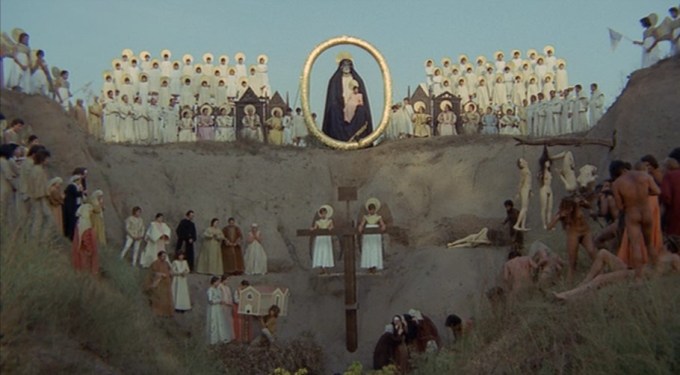
‘Decameron’ is shot by photographer Tonino Delli Colli in the bright summer light and bold colours of a renaissance fresco or manuscript. The films costumes by Danilo Donati and scenic design by Dante Ferretti quote liberally from medieval art particularly the works of Giotto and Raphael. The peasant antics and mystic imagery of Breughel’s work, notably ‘Battle of Lent’ (1559) and ‘Triumph of Death’ (1562) are found here too but they are gentled in their transposition from wintry northern Europe to sunny Italy. The character played by Pasolini himself in the film is described as a ‘disciple of Giotto’ and the artist’s immersion in the world about him forms a thematic context for Boccaccio’s tales.
‘Decameron’ is an infectiously optimistic film. It has an informal, rambling structure as tales flow into and out of each other like drunken tavern gossip. Taking the common mediaeval theme of reversal of fortune, fools and criminals triumph whilst authority figures are mocked. The film begins with the exploits of murderer Ciapelletto (Franco Citti) then follows the misadventures of rich fool Andreuccio (Ninetto Davoli), a credulous dupe who ends up tricked out his wealth and quite literally ‘in the shit’. Andreuccio reverses his bad luck after falling in with some grave robbers and stealing from the church. After tales involving lustful nuns and adulterous wife Peronella (Angela Luce) we return to Ciapelletto as he dies spouting a ridiculous false confession (illicit cravings for lettuce being one of his more onerous sins) and see him posthumously revered as a saint. The second half of the film uses the painting of a fresco as a framing device for more tales of life, death, sex and religion.

The film is gently anti-clerical but despite some violence (the film begins with a murder) the emphasis remains on love and forgiveness. When Caterina (Elisabetta Genovese) is discovered trysting naked on the roof her parents forgive the young lovers and urge them to enjoy themselves whilst they can, her suitor is rich and will bring the family good fortune. The tragedy of Isabetta and Lorenzo (Guiseppe Arrigio) focuses on love which transcends death and Isabetta’s recovery and cherishing of her dead lover’s head is touching rather than macabre. Church authority is never a threatening presence in the film. Pasolini’s nuns and friars are as prone to the needs of the flesh as their flock. Catholicism is tempered by social custom and sexual behaviour is regarded with pragmatic indulgence. At one point a dead sinner returns to tell his surviving brother that no one worries about carnal sin in the afterlife so he’s free to indulge his lust whilst he can. The fresco artist’s climactic vision of the final judgement focusses on the Madonna (Silvana Mangano) rather than the infant Christ. She smiles serenely and indulgently on human sin, radiating humanity and forgiveness. Pasolini does not linger on the tormented sinners, punishment is presented as an equal part of a natural structure that also includes love and redemption.
Even if you don’t share Pasolini’s simple faith in the truth and beauty of peasant culture it is difficult to criticise a film that is so generous and open to the viewer. It’s almost as if the director sits down next to you, buys you a couple of drinks and starts talking. Given his untimely death in 1975 it is rather poignant to see him so full of life here. Pasolini’s style is occasionally mannered (his speeding up of the action to stress moments of humour is grating) and viewers who appreciate tight structure and logical narrative will accuse the film of being messy or incoherent, but the enthusiasm of the performances and beauty of the imagery are irresistible.
Pasolini’s ambition in tackling these story cycles is remarkable. The Decameron, Canterbury Tales and the Arabian Nights intertwine and intersect, tales recur and are reworked to illustrate the universalities of human experience, shared fears, hopes and desires. Pasolini’s project reminds us of the importance of storytelling in all human cultures and places our own cultural obsessions into historical perspective. Our films, music and literature return obsessively to themes of love and death as we try to understand our place in the universe and cope with life’s vicissitudes. Pasolini’s ‘Decameron’ is life-affirming cinema in its purest form, a celebration of human frailty, tolerance and the possibility of redemption; it leaves you eager to see the rest of the trilogy.
Quotes:
“I wonder…why produce a work of art when it’s nice to just dream about it?” – Painter (Pier Paolo Pasolini)
Connections
Film
‘The Saragossa Manuscript’ directed by Wojciech J. Has (1965)
‘The Canterbury Tales’ directed by Pier Paolo Pasolini (1972)
‘The Arabian Nights’ directed by Pier Paolo Pasolini (1974)
‘Blanche’ directed by Walerian Borowczyk (1971)
‘Prospero’s Books’ directed by Peter Greenaway (1991)
‘Pasolini’ directed by Abel Ferrara (2014)
Reading
Sam Rohdie, The Passion of Pier Paolo Pasolini, UK, BFI (1995)
Giovanni Boccaccio, The Decameron, UK, Penguin (1995)
Jan Potocki, Tales from the Saragossa Manuscript, UK, Dedalus (1991)
Robert Irwin, The Arabian Nights: A Companion UK, Penguin (1994) (Irwin traces the interconnections between the stories in Decameron, Canterbury Tales and Arabian Nights and provides a good summary of the history of these works)
Music
Dead Can Dance, Aion, 4AD, (1990)
Carl Orff, Carmina Burana, EMI, (1990) (many recordings available)
 simplysourdust
You must be logged in to post a comment.