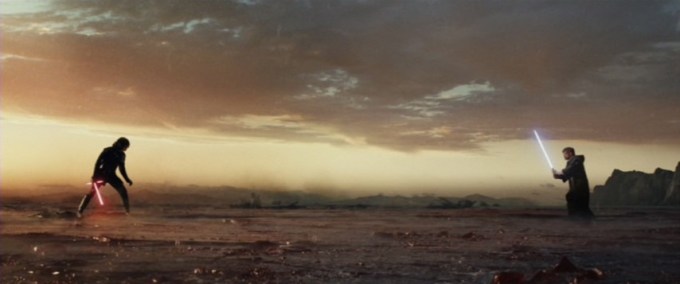
Directed by Rian Johnson, 2017, 152 minutes
The First Order has destroyed the Republic and now harries the Resistance fleet across the galaxy. On a remote planet Rey (Daisy Ridley) confronts Luke Skywalker (Mark Hamill) and asks him to return and revive the failing rebellion.
When J. J. Abrams delivered his eagerly anticipated Star Wars sequel in 2015 fans heaved a collective sigh of relief. Mindful of the critical apathy and fan hostility that accompanied George Lucas’ prequels Abrams pulled off a tricky balancing act and created a lyrical love letter to the franchise. Its blend of mechanical effects with computer-generated imagery acts as an antidote to the digital overload of the prequels whilst winning performances from Daisy Ridley and John Boyega mesh well with returning stars Carrie Fisher and Harrison Ford. Abrams’ enthusiasm compensates for a story that recalls ‘A New Hope’ (1977) and adds some twists. ‘The Force Awakens’ was touchingly nostalgic for older viewers whilst new the characters engaged a fresh generation of followers and the story raised enough unanswered questions to pique the curiosity of serious fans. Disney capitalised on the film’s success by announcing spin-off projects to ease the wait for the next instalment.
Best known for his comedy ‘The Brothers Bloom’ (2008) and his striking time-travel tale ‘Looper’ (2012) Director Rian Johnson was a bold choice to follow up Abram’s opener. Audience expectations were high in advance of ‘The Last Jedi’ but when the film opened unsettling events disturbed Disney’s galaxy far, far away. Despite positive reviews from critics who would normally dismiss Star Wars out of hand, audience response was muted and sometimes hostile. A wave of rancour engulfed ‘The Last Jedi’: The ‘fan cut’ that removed almost all the female characters, racist and misogynist social media campaigns against actress Kelly Marie Tran and death threats for Johnson. Despite the financial success of ‘The Last Jedi’ Disney paused to reconsider the future of the series. Viewers that grew up with Star Wars and cared about its future were dismayed by the negative reaction to Johnson’s film. Concerns that his work to keep the series fresh would be reversed were justified. ‘The Rise of Skywalker’ (J. J. Abrams, 2019) tries so hard to avoid criticism that it fails disastrously. This self-congratulatory group hug stifles narrative tension with a breathless barrage of cameos and in-jokes. Cynical attempts to side-line unpopular characters and reverse Johnson’s narrative choices pander to the worst excesses of fan prejudice. It’s difficult to understand why ‘The Last Jedi’ proved so divisive; once you look beyond the spite the merits of Johnson’s film shine through but the controversy surrounding the film raises significant questions about the tension between creative freedom and fandom.
The plotline of ‘Force Awakens’ raised many more questions than it answered and spawned a ferment of fan speculation. By the time ‘The Last Jedi’ opened the Star Wars community had spent two years attempting to work out the provenance and significance of these new characters. Some fans were enraged when Johnson’s screenplay provided answers that they didn’t want to hear or that contradicted their own intricately crafted theories. Fan fiction feeds on nostalgia, recycling story elements and favourite characters; when Johnson disrupted fandom’s intimate relationship with the material, he was courting disaster. The interplay between fan and fiction becomes corrosive when it constrains creativity and Star Wars requires more than self-cannibalism. The franchise must attract new viewers or risk becoming a snobbish members-only club policed by zealous fans. As much as some fans loathe the prequels they did, unquestionably, offer a plethora of new material. The intricate, art-deco feel of these films suited their prelapsarian setting and the excessive CGI complements their ‘period’ style. Prequel detractors miss the point: There is a certain narrative bravura in recasting the series as the story of Anakin Skywalker’s fall and redemption, but the inevitability of Lucas’ narrative rather than the florid visuals makes the prequels feel unsatisfying. The viewer already knows much of what is going to happen, the rest is detail.
In contrast Rian Johnson seizes the initiative after J.J. Abrams’ first act and confounds expectations with a constantly unpredictable story. His willingness to take narrative risks gives his film a sharper edge. ‘The Last Jedi’ exploits the bathos of Skywalker’s (Mark Hamill) response to Rey (Daisy Ridley) to subvert the hackneyed master and apprentice dynamic and reconsider the implications of Lucas’ dualistic theology. Adam Driver’s Kylo Ren is a complex, conflicted villain. Caught between the light and the dark, viewers of a certain age will understand Ren’s emotional turmoil and his longing to be free of the past. His relationship with Rey creates a frisson of dramatic tension and his deliciously devious ascent trumps the stolid predictability of Vader’s arc to make him a more nuanced antagonist.
‘Last Jedi’ challenges the rather staid gender politics of the Star Wars series. The development of significant female characters is long overdue, and here women drive the plot rather than acting as adjuncts (mothers or lovers). The fact that some fans found this intimidating says more about their insecurities than it does about ‘political correctness’. The First Order remains monolithically male but at least we have the pleasure of Gwendoline Christie’s Phasma and some rather stern flight officers. On the rebel side Johnson gives Leia (Carrie Fisher) wisdom and gravitas, an inspiring leader worn down by military and personal losses. He also introduces Amilyn Holdo (Laura Dern), an unknown quantity whose inscrutable leadership style infuriates mercurial flyboy Poe (Oscar Isaacs) but who proves herself a formidable strategist. New character Rose Tico (Kelly Marie Tran) provides a view from the trenches and injects some mild socio-political commentary when she points out that empires are propped up by money and wars make some people rich. Such entry-level politics are a little ironic coming from Disney but still represent a step up from the crude light-versus dark dynamic of the previous films, unfortunately this upset some fans who felt that Johnson had ‘politicised’ their escapism. Most daringly, Johnson suggests that bloodline is unimportant, that we don’t need to be part of a special dynasty to take a stand. Tony Gilroy’s “Andor” (2022), the best of the Disney spinoff series works so well because it shifts attention from Jedi super heroics to focus on the sacrifices of ordinary people as they struggle against overwhelming oppression.
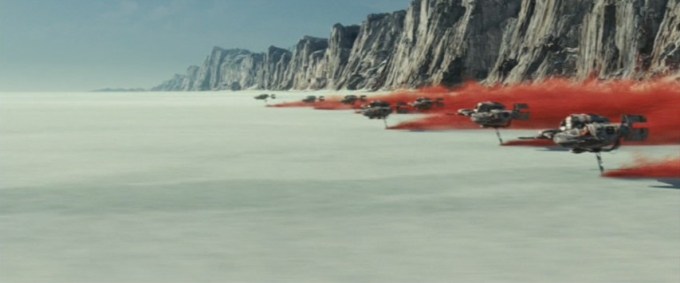
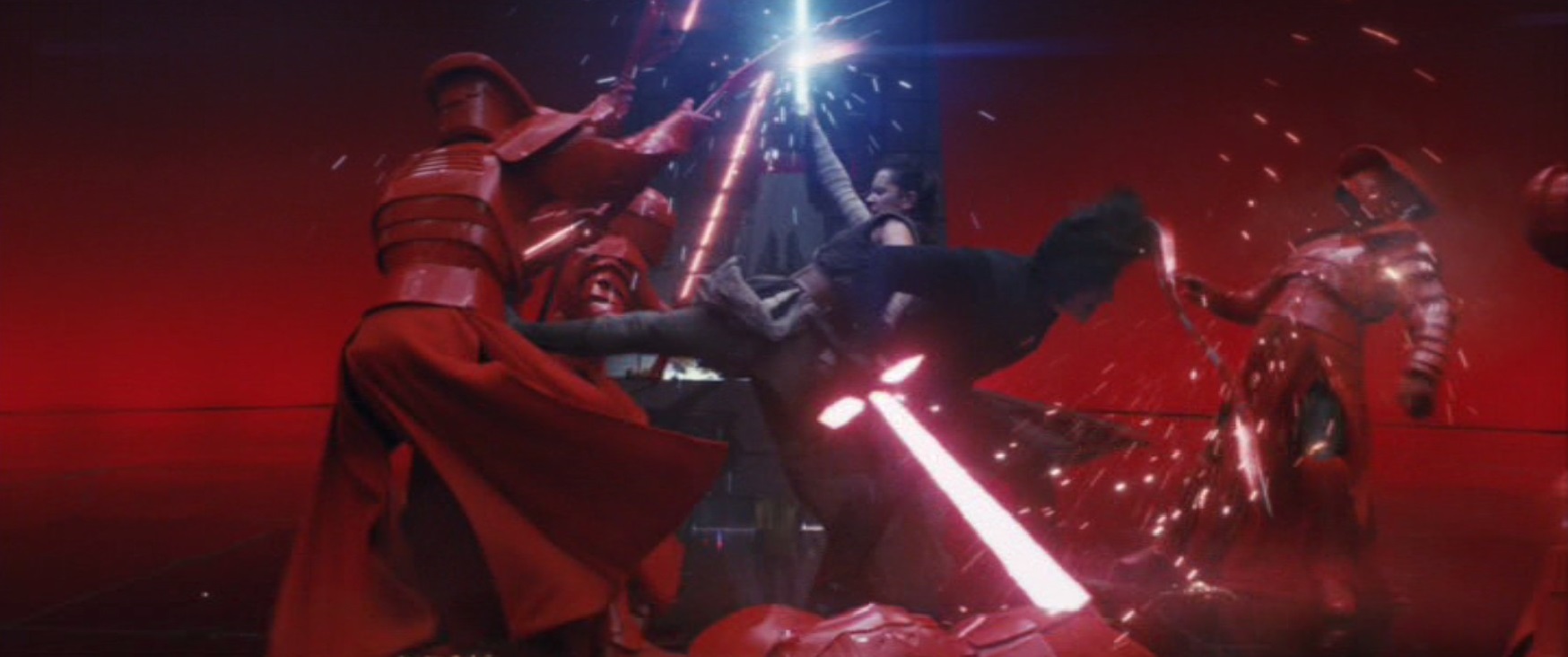
Johnson acknowledges series heritage but is not enslaved by it: The Canto Bight casino recalls the cantina from ‘A New Hope’ but here the ‘wretched hive of scum and villainy’ is comprised of the super-rich rather than spaceport trash and desperados. Crait looks a little like Hoth and Snoke’s imperial guard nostalgically recall the emperor’s cohort in ‘Return of the Jedi’ (Richard Marquand, 1983) but Johnson uses such references for his own purposes: The salt flats of Crait have a vivid vermillion substratum, blood red trails gouged across the white landscape symbolise the desperation of the rebels’ last stand and set up a clever narrative reveal. The throne room confrontation with Snoke’s scarlet praetorians is not just a clever twist on the climax of the original trilogy but also becomes one of the series most exhilarating set-pieces.
Humour too often falls flat in Star Wars. Lucas’ prequels are too dependent on clumsy slapstick and the original trilogy’s witty one-liners have faded with over-familiarity. Johnson’s wry sense of humour may have offended some fans, but his comic timing and visual wit are impeccable: Look out for the Imperial Laundry and and its sly visual pun referencing a certain bounty hunter’s iconic spacecraft; enjoy the antics of those adorable, marketable porgs then guffaw as Chewie stolidly barbecues one for his supper. Johnson’s characters never take themselves too seriously and the film is better for it; a sense of irony makes them more sympathetic than the cardboard cut-outs so common elsewhere in the Star Wars universe.
“Last Jedi” embraces the theme of renewal. These characters must transcend the past to create their own futures. Kylo Ren’s path may be rather extreme (kill your parents) but even Luke learns that the past must die to allow the future to be born. As Johnson energetically slaughters sacred cows, he is clearing the way for fresh thinking. The film’s final image suggests that the allure of Star Wars transcends the hackneyed plot elements that make up Lucas’ original story, the lightsabre must pass to younger hands. We must challenge the toxic fan response to ‘The Last Jedi’ not only because of the emotional damage that it causes but also because it stifles creativity. We value artists because they create novelty, not because they create what we want them to create. ‘The Last Jedi’ works so well because it breaks rules. It isn’t perfect; the chase through Canto Bight is too long and Finn’s showdown with Phasma feels rushed but Johnson gets so much right that these are minor quibbles. This is a Star Wars film for people who don’t normally watch Star Wars. For most of us, particularly the young, living in societies governed by tired, old politics and trapped by nostalgia the prospect of change, even in a galaxy far, far away, is welcome.
Quotes:
“Let the past die. Kill it if you have to. That’s the only way to become what you were meant to be.”
Kylo Ren (Adam Driver)
“Heeded my words not, did you? Pass on what you have learned. Strength, mastery. But weakness, folly, failure also. Yes, failure most of all. The greatest teacher, failure is. Luke, we are what they grow beyond. That is the true burden of all masters.”
Yoda (Frank Oz)
Connections:
Films:
‘Star Wars: A New Hope’ directed by George Lucas (1977)
‘Star Wars: The Empire Strikes Back’ directed by Irvin Kershner (1980)
‘Looper’ directed by Rian Johnson (2012)
Television
‘Battlestar Galactica series 1-4’, various writers, various directors, NBC/Universal, 2004-2009
‘Andor’, created by Tony Gilroy, various writers, various directors, Disney, 2022
Reading:
Phil Szostak, The Art of Star Wars – The Last Jedi, Abrams, 2017, ISBN 9781419727054
Brian Jay Jones, George Lucas: A Life, Headline, 2017, ISBN 9781472224316
 simplysourdust
You must be logged in to post a comment.